
- Home
- About Us
- Courses
- Placements
- Blog
- From Static Designs to Stunning Visual Stories: Start Your Motion Graphics Journey
- Is Animation a Good Career Option in 2027? Future Scope, Jobs & Opportunities Explained
- Behind Every Spectacular Scene: The Role of VFX Artists in Modern Entertainment
- Unlock Your Creative Potential: Master the Art of Game Design
- Top 5 Skills You Will Gain from MAAC Ameerpet’s Advanced VFX Program
- Motion Graphics Career Path: Skills, Salary & Opportunities Explained
- Top Creative Courses After 12th: VFX, Gaming, Animation & Digital Design
- Unlocking Creativity: The Best Gen-AI Tools for Content Creators
- UI/UX Basics Explained: Skills, Tools & Career Opportunities
- Your Dream Graphic Design Career Starts Here: Top Institute in Hyderabad Offering Practical Learning
- Next-Gen Game Design: What Every Creative Student Must Learn
- Top Animation Trends in 2026: What Every Creative Student Should Learn
- From Beginner to Pro: Start Your VFX Journey Today
- Design the Next Big Game: Start Your Journey in AR/VR & Game Development
- Master Visual Effects (VFX): Build a High-Paying Creative Career with MAAC Ameerpet
- Contact Us
Real-Time Rendering vs Traditional Rendering: What Animators Need to Know
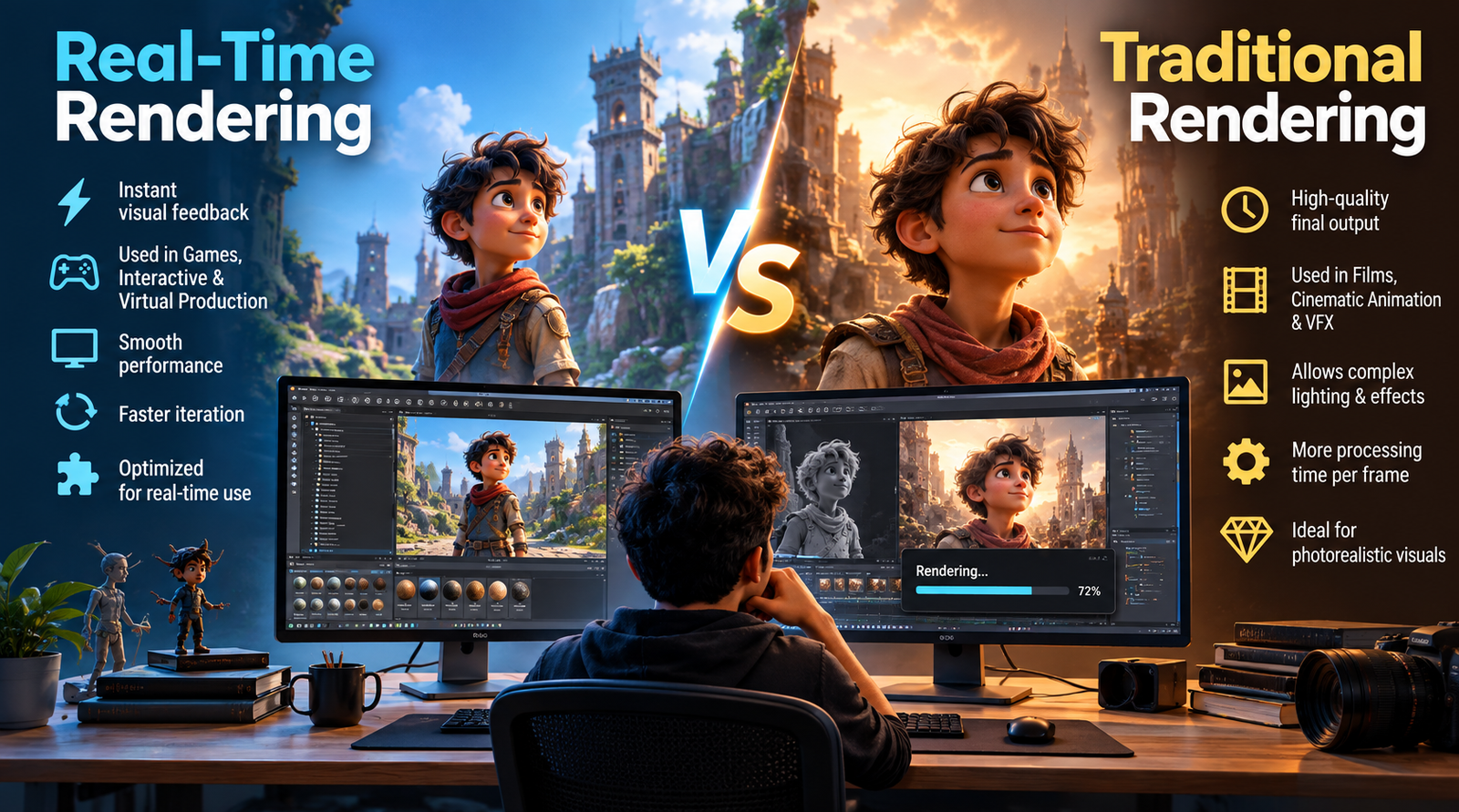
Rendering is one of the most important stages in 3D animation. It transforms 3D models, textures, lighting, environments, effects, and camera information into the final images viewers see on screen. As animation technology continues to evolve, artists increasingly encounter two major approaches: real-time rendering and traditional rendering.
Both methods have important roles in modern animation, gaming, VFX, advertising, and filmmaking. For students considering a 3D Animation Course in Hyderabad, understanding how these rendering methods differ can help them develop skills suited to current production workflows.
What Is Traditional Rendering?
Traditional rendering, often associated with offline rendering, creates images by calculating lighting, shadows, reflections, textures, materials, and other visual information before the final frame is produced.
Depending on the complexity of a scene, rendering a single high-quality frame may take seconds, minutes, or considerably longer. Since animation typically contains many frames per second, rendering an entire sequence can require significant computing resources and production time.
Traditional rendering is commonly used when creators need highly detailed imagery and have more time available to process each frame. It remains relevant in animated films, cinematic sequences, architectural visualization, advertising, and visual effects.
Students joining an Animation Course in Hyderabad should understand traditional rendering because it teaches essential concepts such as lighting, materials, shadows, cameras, composition, and image quality.
What Is Real-Time Rendering?
Real-time rendering is designed to generate images fast enough for viewers to interact with or experience a scene immediately.
Instead of waiting for every frame to be rendered beforehand, real-time engines continuously calculate and display frames as the user moves through an environment or interacts with it.
This approach is essential for video games, where players expect immediate visual responses to their actions. However, real-time technology now extends well beyond gaming. It is increasingly used in animation visualization, virtual production, interactive experiences, simulations, architectural visualization, and filmmaking.
For anyone pursuing a 3D Animation Training Institute in Hyderabad, learning real-time workflows can provide useful exposure to the changing relationship between animation, gaming, and filmmaking.
Real-Time Rendering vs Traditional Rendering
The biggest difference between the two approaches is when and how quickly images are generated.
Traditional rendering prioritizes the creation of a finished frame without requiring it to respond instantly to user interaction. Artists can use computationally intensive techniques to achieve sophisticated lighting, reflections, shadows, and effects.
Real-time rendering, on the other hand, needs to maintain sufficient speed for smooth playback or interaction. Artists therefore need to think carefully about scene complexity, geometry, textures, lighting, optimization, and performance.
The visual gap between the two approaches has also narrowed as real-time engines have become more sophisticated. Modern tools can produce impressive lighting and environments while providing artists with immediate visual feedback.
This makes real-time skills increasingly relevant for students searching for the Best 3D Animation Course in Hyderabad.
Why Real-Time Rendering Matters for Animators
One major advantage of real-time rendering is faster creative feedback.
Imagine adjusting a light in a 3D environment and immediately seeing how the final scene changes. Instead of repeatedly waiting for long renders, animators can experiment with camera positions, lighting, materials, and environments more quickly.
This can make the creative process more iterative. Artists can try multiple ideas, identify problems earlier, and communicate visual decisions more easily with other team members.
Students taking 3D Animation Classes in Hyderabad can benefit from understanding these workflows because speed alone is not the goal. The important skill is learning how to make effective creative decisions while working within technical limitations.
Traditional Rendering Still Matters
The growth of real-time rendering does not mean traditional rendering has become obsolete.
Offline rendering remains useful when productions require highly controlled visuals, complex simulations, detailed lighting, or specific image-quality requirements. Different studios and projects may also use hybrid pipelines that combine traditional and real-time techniques.
Therefore, aspiring artists should avoid thinking of the question as simply “Which rendering method is better?”
A stronger approach is to understand the advantages, limitations, and applications of both.
Students looking for a 3D Animation Institute in Hyderabad should build strong fundamentals before focusing exclusively on one technology.
Skills Needed for Modern Rendering Workflows
Regardless of the rendering method, animators benefit from understanding several core areas:
- 3D modelling and texturing
- Lighting and composition
- Materials and shaders
- Camera techniques
- Character animation
- Rendering fundamentals
- Scene optimization
- Visual storytelling
- Pre-production and post-production
- Real-time production workflows
These skills are useful across animation, VFX, games, digital media, and related creative industries.
For students searching for a 3D Animation Course After 12th in Hyderabad, developing both artistic and technical knowledge can provide a stronger foundation than simply learning individual software commands.
Real-Time Rendering in Games and Virtual Production
Gaming is one of the most familiar applications of real-time rendering. Game engines need to produce responsive environments while characters, lighting, effects, and objects change according to player actions.
Virtual production has expanded these possibilities further. Real-time engines can allow production teams to visualize digital environments during filmmaking and make creative changes more quickly.
As animation, gaming, VFX, and filmmaking workflows increasingly overlap, students pursuing a 3D Animation and VFX Course in Hyderabad can benefit from understanding how assets move between different production environments.
Which Should Beginners Learn?
Beginners should first concentrate on animation and design fundamentals rather than treating rendering engines as shortcuts.
Understanding modelling, textures, lighting, composition, animation principles, and storytelling makes it easier to adapt to different rendering technologies later.
Once those foundations are established, exposure to both traditional and real-time rendering can help students understand how professional production pipelines differ.
If you are researching a Professional 3D Animation Course in Hyderabad or an Animation Training Institute in Ameerpet, check whether the curriculum provides practical project work alongside theoretical knowledge.
Learn 3D Animation at MAAC Ameerpet
For students interested in developing practical animation skills, MAAC Ameerpet is an option to consider for structured training in animation and related creative disciplines.
The AD3D EDGE Plus program is designed around different stages of animation filmmaking, including pre-production, production, and post-production. Students considering a 3D Animation Course in Ameerpet can review the current curriculum, software covered, practical projects, portfolio development opportunities, course duration, and placement support before enrolling.
For those searching for an Animation Institute in Ameerpet, 3D Animation Training in Ameerpet, or Animation Course in Ameerpet Hyderabad, MAAC Ameerpet provides a pathway to explore animation training in a structured learning environment.
Conclusion
Real-time and traditional rendering are not competing technologies where one must completely replace the other. They are different approaches suited to different creative and technical requirements.
Traditional rendering remains important for high-quality offline production, while real-time rendering provides speed, interactivity, and faster visual feedback. For aspiring animators, understanding both workflows can provide a broader foundation for animation, gaming, VFX, and filmmaking careers.
As production technology evolves, the most valuable skill is not simply knowing how to press “render”—it is understanding how to create compelling visuals efficiently while choosing the right workflow for each project.
#3DAnimationTrainingInstituteInHyderabad #3DAnimationCourseInHyderabad #Best3DAnimationCourseInHyderabad #3DAnimationInstituteInHyderabad #AnimationCourseInHyderabad #AnimationTrainingInstituteInHyderabad #BestAnimationInstituteInHyderabad #3DAnimationClassesInHyderabad #3DAnimationTrainingInHyderabad #Professional3DAnimationCourse #3DAnimationCourseAfter12th #AnimationCourseAfter12th #3DAnimationAndVFXCourse #AnimationAndVFXCourseHyderabad #3DAnimationCourseInAmeerpet #AnimationInstituteInAmeerpet